
So, what is a trademark?
A trademark is generally a word, phrase, symbol, or design, or a combination thereof, that identifies and distinguishes the source of the goods of one party from those of others.
Many folks confuse trademarks, copyrights, and patents. They are not the same thing – they each protect a different type of intellectual property. A trademark typically protects brand names and logos used on goods and services. A copyright protects an original artistic or literary work. A patent protects an invention. For example, if you invent a new kind of fermentation vessel, you would apply for a patent to protect the invention itself, apply to register a trademark to protect the brand name of the vessel, and possibly register a copyright for the magazine advertisement that you use to market the vessel.
Folks also get confused about the difference between the symbols TM, SM, and ®. If you claim rights to use a mark, you may use “TM” (trademark) or “SM” (service mark – same thing as a trademark except used for services rather than goods) to alert the public to your claim of ownership of the mark, regardless of whether you have filed an application with the United States Patent and Trademark Office (USPTO). However, you may use the federal registration symbol “®” only if your mark is actually registered with the USPTO.
Should you register your trademark?
There are advantages to registering your mark with the USPTO, but you don’t have to register your mark to establish rights in it. You can establish such rights based on use of the mark in commerce, without a registration. Some of the advantages to registration include:
- A legal presumption of your ownership of the mark and your exclusive right to use the mark nationwide on or in connection with the goods listed in the registration (whereas state registration only provides rights within the border of that one state, and common law rights exist only in your distribution area plus a reasonable zone of expansion);
- Public notice of your claim of ownership of the mark;
- Listing in the USPTO’s online database, which means that your mark is more likely to appear in a trademark search and thus deter others from using an identical or similar mark (hopefully);
- The right to use the federal registration symbol “®”;
- The ability to bring an action concerning the mark in federal court; and
- The use of the U.S. registration as a basis to obtain registration in foreign countries (want to sell your craft brew in Europe, Latin America, etc.?)
Categories of trademarks:
Because not every mark is registrable with the USPTO nor is every mark legally protectable, it is very important that you carefully choose or create your mark. You will need to consider whether your mark will likely be confused with another mark already registered or with a mark that is unregistered but which you know is in use. For example, this past May, Magic Hat filed a lawsuit against Lexington, Ky-based West Sixth Brewing Company, in the United States District Court in Lexington Kentucky, alleging that trademark infringement concerning designs and trade dress associated with the Magic Hat #9 brand. Magic Hat asserted that the logos of the two brands are “confusingly similar.” Fortunately, Magic Hat and West Sixth Brewing were able to find a resolution.
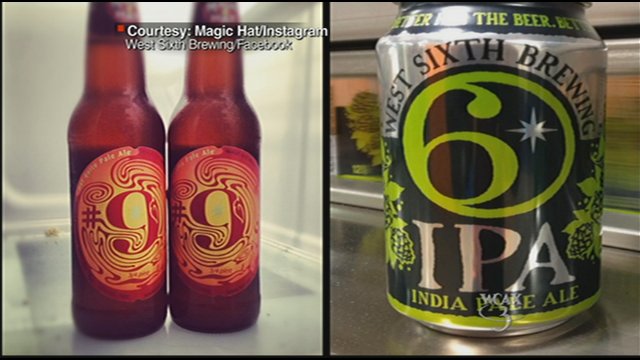
See http://www.brewbound.com/news/marking-territory-beer-companies-start-trademark-battles.
Generally speaking, these are the basic trademark categories: (1) fanciful/coined, (2) arbitrary, (3) suggestive, (4) descriptive, and (5) generic.
(1) Fanciful/Coined – invented words with no dictionary or other known meaning. For example, BUSTICOLLA for a malt-based beverage.
(2) Arbitrary – actual words with a known meaning that have no association with the goodsprotected. For example, PAPERCLIP for a malt-based beverage.
(3) Suggestive – words that suggest, but do not describe, qualities or a connection to the goods. For example, WHEAT NECTAR for a malt-based beverage.
(4) Descriptive – words or designs that describe the goods. For example, HEADY or a drawing of a beer mug for a malt-based beverage.
(5) Generic – words that are common, everyday names for goods. For example, BEER for a malt-based beverage.
The strongest categories are fanciful and arbitrary. Suggestive is not as strong as fanciful or arbitrary, but can become stronger through continuous use. Descriptive is considered weak. Generic marks are not protectable.
Filing a trademark application:
The application process for filing a trademark may be complex. Additionally, it will require you to comply with all requirements of the trademark statute and rules. The upfront cost of hiring an attorney may save you from costly legal problems down the road.
Once you have chosen a mark, you must list the specific goods for which you want to register your mark. It is important to accurately describe your goods. For example, it is not a good idea to state that you plan to use your mark with wine, distilled spirits, and beer, if you only actually plan to use it with beer. If the USPTO issues the registration for wine, distilled spirits, and beer, but the mark has not been used in commerce with wine and distilled spirits, the registration can be subject to cancellation based on fraud.
Additionally, the application must specify your “basis” for filing. The primary types of bases for filing are “use-in-commerce” and “intent-to-use.” To file under the “use-in-commerce” basis, you must be using the mark in the sale or transport of goods in “interstate” commerce. You may file under the “intent-to-use” basis if you have not yet used the mark in interstate commerce but plan to so in the future. Note: you must have a good faith or bona fide intent to use the mark in commerce.
Well, what about companies that wish to register a trademark for products intended only for intrastate sale (within a single state) rather than interstate sale. For example, say a couple of guys want to start a nano-brewery in Americus, Georgia and that they have no intention of selling the product outside of Georgia, can they file for federal registration of their trademark? Generally speaking, the answer is no. However, there are other ways of protecting your mark if you aren’t eligible for federal registration, e.g., filing for registration with your respective state.
Timeline:
After your application is filed, it will take approximately three months before the examining attorney will review your application. The entire registration process may take up to a year or more depending on the circumstances. For this reason, it is important to start the process sooner than later.
If the examining attorney does not refuse registration or identify additional requirements, he or she will approve the mark for publication in the Official Gazette, a weekly online publication, and the USPTO will send you a Notice of Publication stating the publication date.
After publication, there is a 30-day period in which the public may object to the registration of the mark by filing an opposition. Absent any opposition, the USPTO generally will issue a registration certificate about 11 weeks after publication, if the application is based upon “use-in-commerce.” If based upon “intent-to-use,” the USPTO generally will issue a Notice of Allowance (NOA) about 8 weeks after publication.
A NOA means that your mark has been allowed, but does not mean that it has been registered. Within 6 months of the issue date of the NOA you must either submit a State of Use or submit a Request for an Extension of Time to File a Statement of Use.
Maintaining a trademark registration:
To maintain your trademark registration, you must file your first maintenance document between the 5th and 6th year after the registration date and thereafter at the time of renewal. The USPTO does not currently send reminder notices when the documents are due. If the documents are not timely filed, your registration will be cancelled and cannot be revived or reinstated, which means that you will have to start the process all over.
Oh, and by the way, the application fee is non-refundable. Measure twice, cut once.
I don’t think Georgia’s bubble is going to burst anytime soon.
Will it fall? A look at America’s brewery boom » Beer | DRAFT Magazine.
The FDA was directed to issue a new regulation by the Food Allergen Labeling and Consumer Protection Act, which directed the FDA to set guidelines for the use of the term “gluten-free.” The recent FDA ruling defines “gluten-free” as food containing less than 20 parts per million of gluten.
Omission Brewing, the first craft beer brand in the U.S. to focus solely on brewing beer specially crafted to remove gluten, is anxious to see how the Alcohol and Tobacco Tax and Trade Bureau (TTB) will apply the FDA guidelines to Omission products.
The TTB regulates beer at the federal level, and ruled in May 2012 that breweries, like Omission, which remove gluten from their beer products, had to label their products with the phrase, “(Processed – OR – Treated – OR – Crafted) to remove gluten,” along with a special disclaimer that the products may contain gluten.
Craft Brew Alliance one step closer to being able to label Omission Beer “gluten-free” | BeerPulse.
Over the years, I’ve had several people ask me questions about non-compete agreements. Generally speaking, it is a contract limiting an employee from competing with his employer if the employee were to leave the company for any number of reasons. These agreements protect a business by restricting the other party from performing similar work for a specific period of time within a certain geographical area. There are two additional types of agreements which intersect with a non-compete agreement: a non-disclosure agreement (confidentiality agreement) and a non-solicitation agreement. Oftentimes, all three agreements – that is, the non-compete, non-disclosure, and non-solicitation, are wrapped up into one agreement, which informally referred to as a non-compete.
For instance, imagine that the owner of a brewery (let’s call it Old Brewery) hires an assistant brewer, spends time and money to train the assistant, teaches him the craft of brewing, and shares with him recipes and special brewing techniques. After years of investing in the assistant brewer, the owner promotes the assistant to brewmaster. A couple of months later, the newly promoted brewmaster learns of a new brewery opening up in town (let’s call it New Brewery). The next week, at a brewing competition, the brewmaster meets the owners of New Brewery. Knowing the brewmaster’s reputation as an outstanding brewer, New Brewery offers to hire the brewmaster and pay him double the salary. Needing the money, the brewmaster leaves Old Brewery to work for New Brewery.
Well, as you can imagine, this does not please the owner of Old Brewery. The owner ticked off that he spent so much time and money training the brewmaster only to have him leave to compete against Old Brewery – this is where a non-compete would have helped Old Brewery. Further, the owner is also worried that the brewmaster might share some of the recipes and special brewing techniques with New Brewery – this is where a non-disclosure agreement would have helped Old Brewery.
Now, replace the brewmaster in the hypo for the top salesperson at Old Brewery. Consider that Old Brewery, again, spent a lot of time and money training the salesperson. As a result of that investment, the salesperson became great at selling and developing relationships with customers. New Brewery knows about these well-developed relationships, and offers to hire the salesperson at double the pay. So, the salesperson moves on over to New Brewery and starts selling its products by using the relationships he built while at Old Brewery – this is where a non-solicitation agreement would have helped Old Brewery.
Could the owner of Old Brewery have done anything differently to prevent this type of situation from occurring? Had the owner required his former employee to enter into a non-compete agreement (along with some other agreements like non-solicitation and non-disclosure), this situation may not have arisen.
Listen, the point here is not to deny the brewmaster or the salesperson his right to make a living. Rather, the point is to protect the investment a business makes in its employees. Entering into these types of agreements at the outset of an employer-employee relationship helps both parties to have a clear understanding of each other’s expectations.
If you want to further discuss issues involving non-compete agreements, give me a shout.
How long until Georgia catches up with Texas?
For Craft Brewers, New Law Opens Door to Competitive Market – NYTimes.com.
It will be interesting to see how these figures change in the next few years, with the rapid rise in popularity of craft beer.
 Georgia Craft Beer Lawyer