
Most folks paying attention to the craft beer industry have heard of the proposed Fair BEER Act and the proposed Small BREW Act. And most folks probably know that the big breweries, like Anheuser-Busch (AB), support the Fair BEER Act, while craft breweries support the Small BREW Act. But do you know why craft breweries support the Small BREW Act rather than the Fair BEER Act? Well, just in case you are unsure, let’s figure it out together.
The first thing you need to know is that under current federal law a “small” brewery is defined as one producing not more than 2M barrels annually. Why does this matter? Well, because only “small” breweries are eligible for tax savings under current law. You see, under current law, small breweries are charged a federal excise tax in the amount of $7.00 per barrel on the first 60K barrels produced, but large breweries are charged $18 per barrel on all barrels. This means that under current law a small brewery could have tax savings of up to $660,000 on the first 60K barrels.
Current Law
| Barrels Produced | Tax Per Barrel | Total Tax |
| First 60,000 barrels | $7.00 | $420,000 |
| Next 1,940,000 barrels | $18.00 | $34,920,000 |
| First 2,000,000 barrels | $35,340,000 |
Now, what would the Small BREW Act do? First, it would change the definition of a “small” brewery from one producing not more than 2M barrels per year to one producing not more than 6M barrels per year. You might be wondering how many U.S. breweries are in the 2M-6M barrels per year production range. Well, there are not many. In fact, as far as I know, there are only two – Boston Beer Company (BBC) and D.G. Yuengling & Son. But I imagine that there are quite a few breweries who want to be in that production range.
The second thing the Small BREW Act changes is the tax per barrel on the first 60K barrels for small breweries (in this case, breweries producing not more than 6M barrels per year). Remember that under current law the tax is $7 per barrel for the first 60K barrels for small breweries. The Small BREW Act reduces it from $7 per barrel to $3.50 per barrel for the first 60K barrels. That’s $210K more in savings than under current law. Sounds great, right?
Another thing the Small BREW Act changes is the tax per barrel for the next 1,940,000 barrels for small breweries. Under current law the tax is $18 per barrel. The Small BREW Act reduces it from $18 to $16 per barrel. That’s a savings of $3,880,000. It is important to note that the Small BREW Act does not reduce the tax rate for big breweries, which would continue to pay $18 per barrel for all barrels.
Small BREW Act
| Barrels Produced | Tax Per Barrel | Total Tax | Savings v. Current Law |
| First 60,000 barrels | $3.50 | $210,000 | $210,000 |
| Next 1,940,000 barrels | $16.00 | $31,040,000 | $3,880,000 |
| First 2 Million barrels | $31,250,000 | $4,090,000 |
Here’s the text of the bill: Small BREW Act
So, for a brewery producing fewer than 6M barrels per year, these changes could save it up to $4,090,000. Awesome, right? Let’s not jump for joy just yet. Let’s check out the Fair BEER Act.
Fair BEER Act
| Production Rate | Tax Rate |
| 0 – 7,143 barrels | No excise tax |
| 7,144 – 60,000 barrels | $3.50/barrel |
| 60,001 – 2M barrels | $16.00/barrel |
| 2M – plus barrels | $18.00/barrel |
Here’s the text of the bill: Fair BEER Act
At first glance, this seems like a better deal for craft brewers than the Small BREW Act. I mean, hey, no federal excise tax on the first 7,143 barrels. And 90% of American breweries produce fewer than 7,143 barrels. Here’s the thing, though: under the Fair BEER Act, there is no production cap (unlike the Small BREW Act which would apply only to those U.S. breweries producing fewer than 6M barrels). In other words, the reduce tax rate applies to all breweries. Stated differently, big breweries, like AB InBev, would be eligible for the reduced tax rate on their first 2M barrels. The Fair BEER Act also makes another significant, yet subtle, change to current law. Presently, and under the proposed Small BREW Act, the reduced tax rate applies only to domestic breweries, i.e., breweries in the U.S. The Fair BEER Act makes the reduced tax rate apply to not only domestic breweries, but also foreign breweries, i.e., imported beer. Thus, under the Fair BEER Act, American craft breweries would have to compete with not only better-positioned mega brewers, but also better-positioned foreign breweries.
Why does this matter? Because what this all boils down to is competitive advantage. Even though small breweries might save more money under the Fair BEER Act, so would big breweries like AB, and that’s the problem.
The Brewers Association states, “Because of differences in economies of scale, small brewers have higher costs for production, raw materials, packaging and market entry than larger, well-established multi-national competitors.” You see, if the issue is about a comparison of cost per unit of output as between small breweries and big breweries, i.e., economies of scale, then, as the theory goes, the Small BREW Act is more favorable to small breweries, since big breweries are afforded no savings under the Small BREW Act. The big breweries call their Act “fair,” but they aren’t really comparing apples to apples.
Lastly, I think that the gist of this competitive advantage/economies of scale issue is that if AB were to save money in excise taxes it would be able to lower its prices for brands like Shock Top, and thus, theoretically, draw consumers away from true craft beer to “crafty” beer.
Because it can be a useful way to build brands while raising capital to open up a brick/mortar brewery, I get asked about contract brewing frequently.
Here are the basics:
As you know, there are three levels of jurisdiction governing the production and sale of alcoholic beverages: federal, state, and local.
As you also know, there are three tiers within the beverage-alcohol industry: supplier, wholesaler, and retailer. If you plan on contract brewing, you will be operating on the supplier tier.
If this is all news to you, start here:
https://georgiacraftbeerlawyer.com/2013/07/25/so-what-is-this-three-tier-system-anyway/.
Then here:
https://georgiacraftbeerlawyer.com/2015/02/02/distribution-101/.
Then here:
https://georgiacraftbeerlawyer.com/2015/02/03/licensing-101/.
Then read below.
Just in case you haven’t read Distribution 101, I will explain generally how alcohol distribution works in Georgia, because this discussion won’t make sense without such a basic understanding. To start, every supplier must designate one wholesaler as the exclusive wholesaler for each brand for each territory in which the supplier’s products will be sold. There are two primary aspects to alcohol distribution in Georgia: (1) the regulatory designation, and (2) the distribution agreement.
- Regulatory designation: Every supplier who sells alcoholic beverages to a Georgia-licensed wholesaler must designate with the Georgia Department of Revenue (“GDOR”) on an ATT-104 form the brands it is designating to a particular wholesaler for a particular territory. Once designated, aside from a voluntary release from the wholesaler, the only way to terminate the regulatory designation is via a proceeding before the GDOR called a Notice of Intention to Change Wholesaler. You see, in Georgia, a supplier must have cause to terminate its relationship with its designated wholesaler.
- Distribution agreement: A supplier and a wholesaler can enter into a distribution agreement – a contract governing the relationship. The agreement will provide terms regarding case depletion targets, marketing and product promotion, and termination, among many others. While termination of a distribution agreement will not automatically terminate the regulatory designation, the termination provisions can be aligned with the for-cause provisions in the Georgia regulations governing a Notice of Intention to Change Wholesale, which better positions the supplier should it want to terminate the relationship.
According to the TTB, a contract brewing arrangement is a business relationship in which one person, such as a wholesaler or retailer or a brewer, pays a brewing company, the “contract brewer,” to produce beer for him or her. The contract brewer is entirely responsible for producing the beer, keeping appropriate brewery records, labeling the beer with its name and address, obtaining necessary certificates of label approval (COLAs), and paying tax at the appropriate rate upon removal of the beer from the brewery. The contract brewer retains title to the beer at least until the beer is taxpaid or removed from the brewery. The TTB considers contract brewing arrangements to be ordinary commercial arrangements. If this person on whose behalf the beer is brewed under contract resells the beer to a wholesaler or broker, then that person must hold a federal basic permit as a wholesaler under the Federal Alcohol Administration Act, and must comply with all applicable special tax requirements.
Here’s what the business model might look like graphically (sorry for the poor quality…couldn’t copy/paste graph in WordPress…had to take pic with my phone):
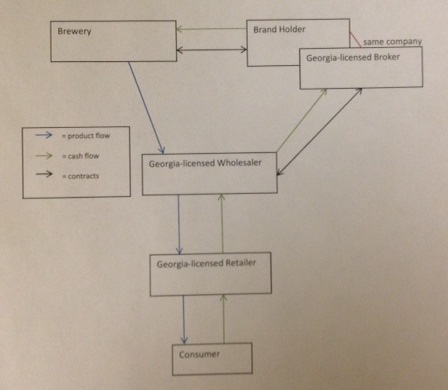
Product flow: The Brewer will produce a specified amount of the Brand Holder’s product, package and label such products, apply for Certificate of Label Approvals (COLAs) for such products, and make available for pick up by or deliver to the designated Georgia-licensed wholesaler(s). The Georgia-licensed wholesaler will, in turn, deliver the product to retail outlets in its territory.
Cash flow: The Brewer will sell the product to the Georgia-licensed broker (the Brand Holder and Georgia-licensed broker are the same company). The Georgia-licensed broker, will, in turn, sell the product (without ever actually taking possession/custody of it) to the Georgia-licensed wholesaler who will, in turn, sell the product to retail outlets in its territory. The retail outlets will, in turn, sell the product to consumers. Thus, the Brand Holder/Broker will make money (hopefully) on the sale of the product to the wholesaler.
Contracts: The Brand Holder will enter into a contractual arrangement with the Brewer. Per this arrangement, the Brewer will produce a specified amount of the Brand Holder’s product, package and label such products, apply for Certificate of Label Approvals (COLAs) for such products, and make available for pick up by or deliver to the designated wholesaler(s) in exchange for a negotiated amount of money. The Brand Holder may license its name to the Brewer to be used as a dba so that when the Brewer applies for the COLAs it can do so under the Brand Holder’s name – this is done so that the small print on the label will say the name of the Brand Holder rather than the Brewer. The location or site of production listed on the label is usually the location of the Brewer. For instance, if, say, Thomas Creek Brewery brewed your product, the label would say “Thomas Creek Brewery, LLC – Greenville, S.C.” If you licensed your brewery’s name (say, Best Beer Ever, LLC) to Thomas Creek, however, the label could read as, “Best Beer Ever, LLC – Greenville, S.C.” See a note on this idea below.
The Georgia-licensed broker will have to designate with the GDOR the brands to a Georgia-licensed wholesaler, and the Georgia-licensed broker may, additionally, have a distribution agreement with the wholesaler. It is highly advisable for the Brand Holder, as the holder of a Georgia’s Broker’s license, to enter into a distribution agreement with its wholesalers (assuming the wholesaler can be persuaded to do so).
Here’s something to consider when deciding whether to have the Brewer apply for COLAs under the Brand Holder’s name: The craft brewing industry is very much about authenticity. Some consumers may think that the Brand Holder is trying to trick them. For instance, when Wild Heaven Craft Beers was using Thomas Creek in South Carolina to brew its product, Wild Heaven decided that it seemed disingenuous to not have the brewer listed as Thomas Creek, said owner Nick Purdy.
Take a look at Wild Heaven’s label below from when it was contract brewing with Thomas Creek. In the bottom left-hand corner you will see the following: “Brewed and bottled to our exacting specifications at Thomas Creek Brewery, LLC Greenville, S.C.”

I think this is a good way to convey to consumers that the recipe is yours, while remaining authentic by informing the public that Thomas Creek actually brewed the product. Now, having constructed a brick/mortar facility, Wild Heaven brews out of its brewery in Avondale Estates, GA.
Next up: I’ll explain an alternating proprietorship and how it differs from a contract brewing business model.
Stay tuned.
 Georgia Craft Beer Lawyer